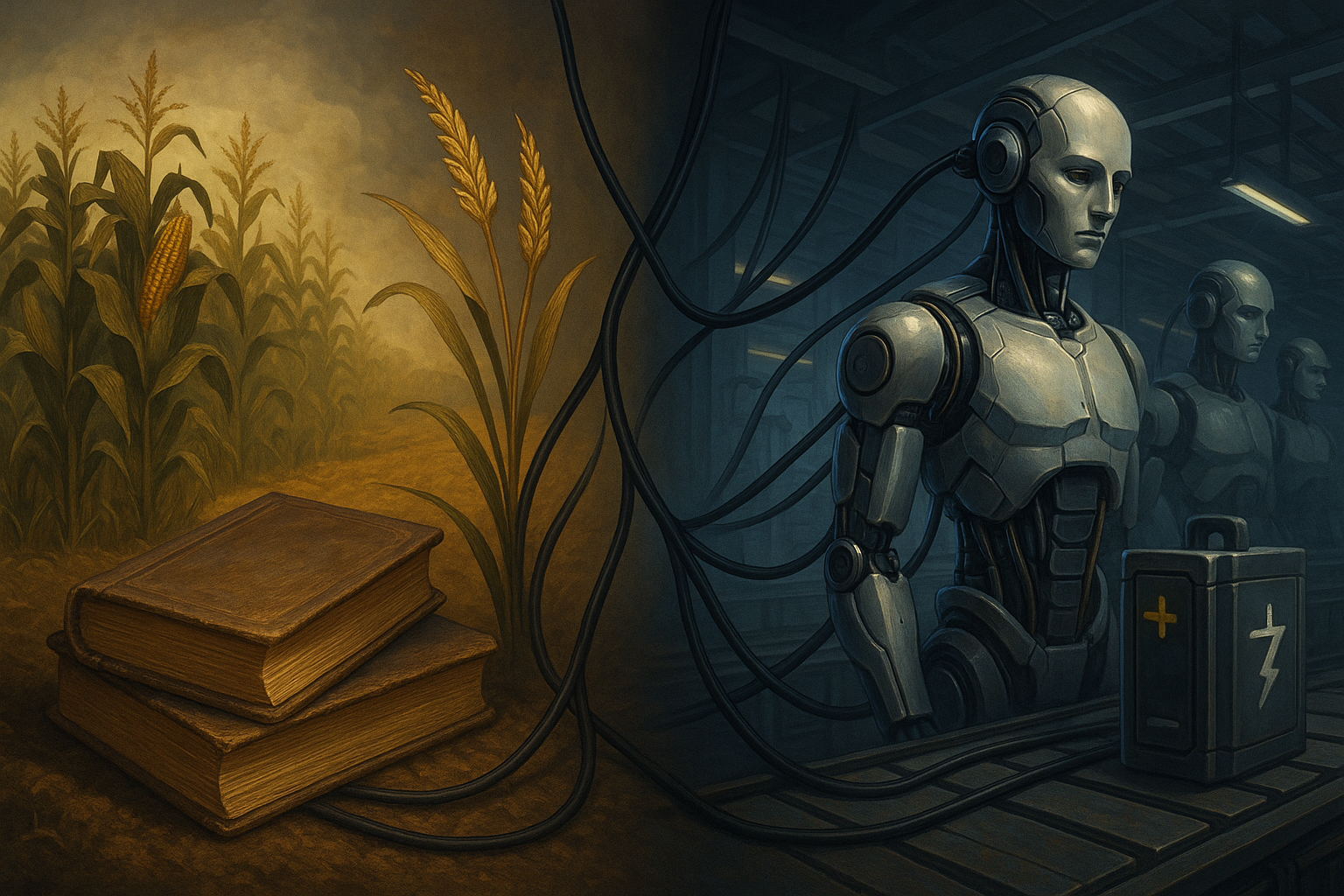
Corn Became Cords
Adam Smith argued that labor is the center of economic value because in his era productive capability lived inside the human body. In The Wealth of Nations, he wrote that "the annual labour of every nation is the fund which originally supplies it with all the necessaries and conveniences of life." He also wrote that "labour was the first price, the original purchase-money that was paid for all things," and that "labour, therefore, is the real measure of the exchangeable value of all commodities."
That framework is still foundational. It is also now incomplete.
The shortest way to say it is this. Corn became cords.
For most of economic history, labor ran on chemical energy. People ate food, converted calories into effort, and built everything from farms to railroads to spreadsheets with that conversion engine. Today, a growing share of labor runs on electricity and software. The worker is no longer always a person with a pulse and a lunch break. Increasingly, the worker is a machine with a battery, sensors, and an update cycle.
This does not make Adam Smith obsolete. It makes him conditional.
His labor formulation assumed intelligence and dexterity were fundamentally human. In 1776, that was obvious. In 2026, that assumption is under pressure from both ends. Physical labor is being automated by robotics and cognitive labor is being automated by AI systems that do not need sleep, coffee, or motivational podcasts.
"The real price of every thing... is the toil and trouble of acquiring it." Smith still holds. The question now is whose toil.
In a humanoid robotics economy, toil shifts from human exertion toward machine uptime and reliability. Trouble shifts from labor scarcity toward control risk, model quality, cybersecurity, and maintenance failures that happen at exactly the wrong moment.
In plain terms, the cost stack starts moving from wages and benefits toward charging, compute, depreciation, and system management. The economy moves from a cost of living model toward a cost of charging model, which sounds like science fiction until you look at industrial capex budgets and realize we are already there.
In one plausible future, nonhuman labor lowers frictions in construction, logistics, manufacturing, and care support. Output rises, costs on key goods ease, and humans move toward higher-judgment work where trust and context still matter more than pure throughput. In that path, productivity growth feels like national strength rather than social extraction.
In a darker future, output rises but participation narrows. A small set of firms controls robot fleets, model infrastructure, and energy contracts. Wage growth weakens, bargaining power deteriorates, and people are told everything is excellent because aggregate charts are green. That gap between "officially strong" and "personally weaker" is where instability grows.
The most likely outcome sits in between. Adoption will be uneven. Sectors with clear task structure automate first. Regions with cheap power and better infrastructure pull ahead. Institutions lag, then scramble, then overcorrect. America does messy transitions better than clean ones.
Across all scenarios, one conclusion remains steady. Energy policy and compute policy are now labor policy in practical terms.
If productive work can be done by nonhuman systems at scale, then reliable electricity and scalable compute are no longer side issues. They are core inputs to competitiveness, wage stability, and national bargaining power.
This is where Smith is still useful. He was trying to explain where wealth comes from and how societies convert productive capacity into living standards. That mission has not changed. The production substrate has.
Human labor converted calories into output. Machine labor converts electricity into output. The underlying physics stayed honest while our economic language got stale.
If output scales without proportional human hiring, wage income alone becomes a weaker distribution channel. If that is ignored, demand fragility grows inside an economy that can produce more than ever. If it is addressed, machine-era productivity can support broader prosperity instead of a cleaner, faster version of old inequality.
Adam Smith gave us a framework for a world where labor had to be human. We now need to extend that framework to a world where labor can be innately nonhuman across a meaningful share of economic activity.
Corn became cords.
The central question for the United States is not whether this transition is real. It is whether ownership, distribution, and institutional design will turn it into shared prosperity or concentrated power with better branding.
If you're trying to make decisions in the real economy - investing, operating, or governing - here are the levers that matter more than the usual talking points:
- Energy is labor. Grid reliability, power pricing, and permitting speed become competitiveness inputs.
- Compute is labor. Model access, inference costs, and secure deployment determine how fast nonhuman work scales.
- Ownership is distribution. If wage income weakens as a distribution channel, who owns the fleets and infrastructure matters more than GDP charts.
- Resilience is the new scarcity. Cybersecurity, maintenance, supply chains, and uptime become the hidden constraint (not headcount).
Arbiter works with investment firms and operators who need clean, decision-grade analysis on automation economics, competitive landscapes, and capital allocation. If you want a short, concrete memo on how "electric labor" impacts your sector, start a conversation or schedule a call.
One high-signal note when there is something worth thinking about.